Kindle Sales and Select Royalty
Copyright 2014 by Morris Rosenthal - All Rights Reserved
How Many Amazon Kindle eBooks Are Selling Based On Sales Ranking
Note: This analysis is in no way sponsored or approved by Amazon.com. For overall book industry sales regularly updated on this site, see: Amazon sales compared to Barnes&Noble and Borders.
Before getting to the graphs, I'd like to clear up one fallacy about how the weighting system works for visibility in the Amazon catalog. When Kindle was first introduced, free and paid books in the Kindle store were given equal weight. But the free books quickly began to dominate the Better Together matches, at least in classic books, and Amazon doesn't make any money on free books. When they changed the weighting algorithm, most of the Kindle publishing world accepting the notion that the weighting was 10:1. I guessed at the time it was closer to 100:1 and I was recently able to confirm this, so beware. You need to give away 100 Kindle books to get the same visibility in the catalog as selling (or gifiting) a single book.
All of the interest from self publishers lately has been in Kindle Select royalties and sales, so I'm going to start including the graphs from the regular Select reports I've been doing on my blog. The Select royalty in December was a bit of a shock to self publishers like myself, who expected a high payoff based on the big bonus Amazon added to the December pot. But it turned out that the opening of the Kindle Owners Lending Library in the UK, France and Germany, plus the huge holiday sales of Kindle Fire devices, added so many new users that the payment actually fell:

Over time, Amazon has shown that they are targeting a royalty of around $2.00 for the Kindle Select program. That means, giving a book away as a Prime borrow earns the publish as much as selling a $2.99 book at a 70% royalty. The remaining graphs on this page may be of historical interest but I no longer keep them up to date because any author can get real-time sales reports through their Kindle Direct Publishing account, and historical graphs of sales rank through Amazon's Author Central.
The following graph is based on my actual sales plus a couple points solved by ratio from my page on estimating book sales from the Amazon sales ranking. Kindle sales are counted for many devices beyond the black-on-grey Kindle, including the color Kindle Fire and the Apple iPad shoppers who buy Kinde eBooks.
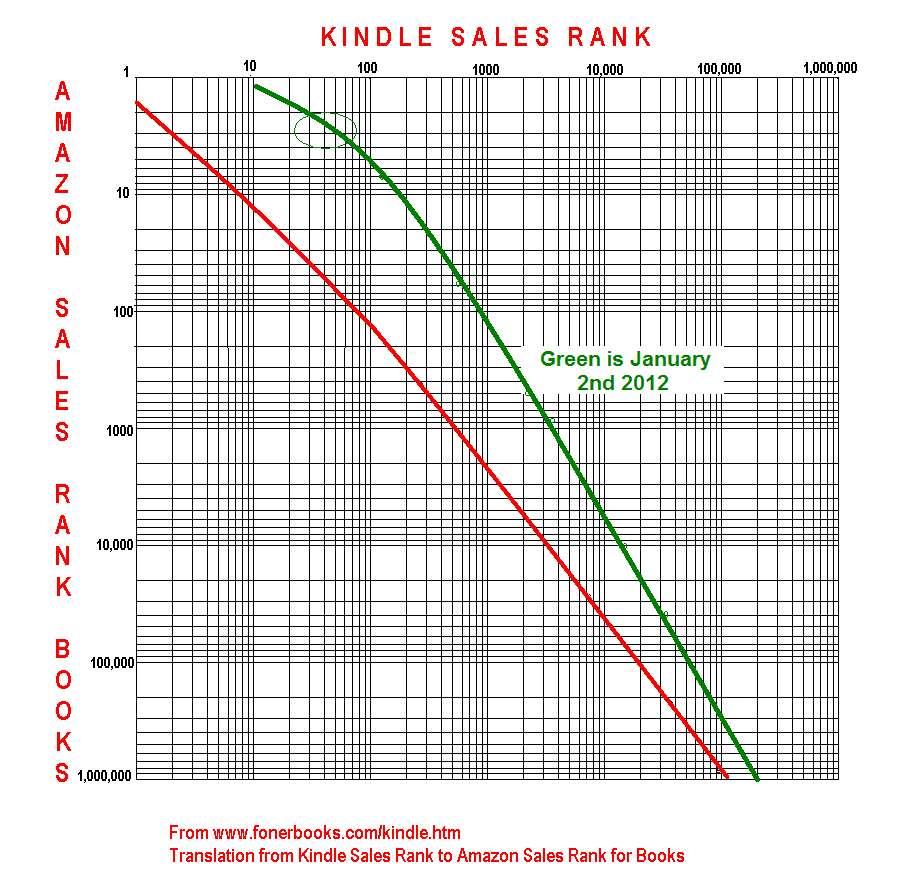
The graph shows how Kindle ranks stack up against regular sales ranks. The green line shows how paid Kindle sales are now well above paper sales, the crossover point doesn't come until around the rank of 20,000, at which point paper and Kindle titles are selling about the same. The particular day I did the graph was a national holiday and just after Christmas, so I'll take another look when people get tired of all their new Kindles and iPads. And the end of the green curve, where the Kindle rank is 200,000 and the paper rank is 1,000,000, is an approximation, since the Kindle line should be approach asymptotic by the time it gets to 700,000, but I'd need another decade on the graph to show that. Both the original red curve from 2009/2010 and the January 2nd, 2012 green curve are based on a series of data points for sales ranks bracketing each other. For the red curve, when paper was still outselling Kindle, I used paper book bestsellers bracketing Kindle bestsellers. Now that Kindle books are outselling paper books like crazy, I used Kindle books bracketing paper books from Amazon category bestseller lists. The large oval shape at the top of the green curve is required since I needed paper points at the top of the curve where Kindle outsells them badly. At the time I drew that "point" the #2, #3 and #4 bestselling paper books fell between the #21 and the #68 Kindle bestsellers! Amazon originally predicted that Kindle sales would pass paperback sales in 2012, but my May 2011, they were already saying that paid Kindle books were outselling all paper books combined. I'm sure it's already happened that free Kindle eBooks are beating them all.
I lack hard data for the top 100 eBooks and the current top 1,000 paper books, but on the lower equivalency graph, I try to extrapolate. I'd appreciate fresh data from anybody with top selling books.
The first graph addresses Kindle ebook sales with an average Kindle sales rank between 100 and 100,000. I don't try to estimate sales for Kindle ebooks with sales ranks below 100 because they are in the head of the curve where I have very limited data and where the actual sales fluctuate greatly with season, number of blockbusters. I wouldn't put too much faith in the eBook sales estimates you may find for the top 10 sellers, it simply varies too much. But I need to update this graph again because the other graph from a few days later showed me that the top of the curve where I had very few data points is probably way off.

It turns out that Kindle eBooks are now selling a lot more copies than I would have guessed just yesterday, and the #1 Kindle title is outselling the #1 paper title, though it's impossible for me to say by how much.. Keep in mind that Amazon has separated the rankings for free Kindle books from the ranks for paid Kindle books. My current estimate is that free Kindle books "sell" (ie, they are downloaded) at around six times the rate of paid Kindle books at the top of the curve. This means that free Kindle books may "outsell" all other book types on Amazon combined (paperback, hardcover, paid Kindle). The main limitation is that there just aren't that many free eBooks in the Amazon store and most of them are pretty obscure, so outside of the top few hundred, paid can offer them competition.
Given that there are only around 700,000 eBooks available for Kindle (last time I checked) it's impressive that they are making such and impact on the head of the long tail. I recently bought a new Kindle Fire, and I don't read on it, I just use it to check the web because it boots much faster than my laptop. I do all of my reading on my 3G Kindle 2, even though the corner of the screen is dead and obscures a part of the last word on every first line. I just prefer the large buttons to my Kindle 3 WiFi, which is otherwise a nice reader. The black-and-white reading experience being much better than I expected, I have practically stopped reading paper books even though a live a ten minute walk from the largest college library in the US. I now wish I'd bought one a couple years ago.
Fiction remains the killer ap for Kindle. Amazon mentioned in an earlier press release that five fiction authors, Charlaine Harris, Stieg Larsson, Stephenie Meyer, James Patterson, and Nora Roberts, have sold over 500,000 Kindle eBooks each.