Sales Ranks in the Age of AI Slop
Amazon has never published an equivalency table showing how sales (and Kindle Unlimited borrows) correspond with sales rank. It's complicated, because sales rank is a relative measure, sales of a book or product versus all other books or products in the same broad category in the store. Since sales vary by time of day, day of the week, holidays, and seasons, it's never been possible to say with precision that a sales rank of x equals sales of y, and that's where most people gave up.
McGraw-Hill published my first book with them, The Hand-Me-Down PC, back in 1997, and then, silence. My contract stipulated semi-annual royalty reports, plus there was a three-month reserve against returns, meaning that the advance was all I could expect to see the first year. But in 1998, Amazon introduced sales rank, sometimes abbreviated as BSR for Bestseller Sales Rank, and I became an instant addict. At first, like many other authors, I was checking the sales rank on my book every time I turned on the computer, in addition to category rankings to see how I was doing against the competition. I became obsessed with the overall system, and by the time my second McGraw-Hill book was released (with quarterly reports), I also had data from self-publishing and Amazon Associates reporting of sales through my website, and began building an equivalency model.
The early sales rank system was more complicated than the picture today because Amazon didn't update the ranks of slower sellers to save on compute, leading to a large discontinuity at the rank of 100,000 when the number dropped to what I called back then a steady-state rank. Using log-log graph paper from my engineering days and my trusty French curve, I sketched a line with the points that I had and posted it online.
It was the first public explanation of how sales ranks equated to sales, and even though this was pre-Google, the paged drew hundreds of visitors a day from search. There was a single afternoon when I received calls from both New York Times and Wall Street Journal reporters looking for information about Amazon sales, and another time I heard from an economics professor who currently sits on the board of the Federal Reserve and may one day be the Fed Chairman. I believe he was disappointed by my explanation about the French curve.
Sales rank is largely irrelevant for self-publishers unless they're doing research into competition because Amazon's Kindle Desktop Publishing program for both eBooks and paper books offers sales reporting that's almost real-time. There's no need to study your sales rank when you can get the numbers directly, so I stopped updating (in tech-speak, deprecated) this page. But recently, there's a new phenomenon in sales rank which is worth talking about, especially on the Kindle side, and that's the AI takeover.
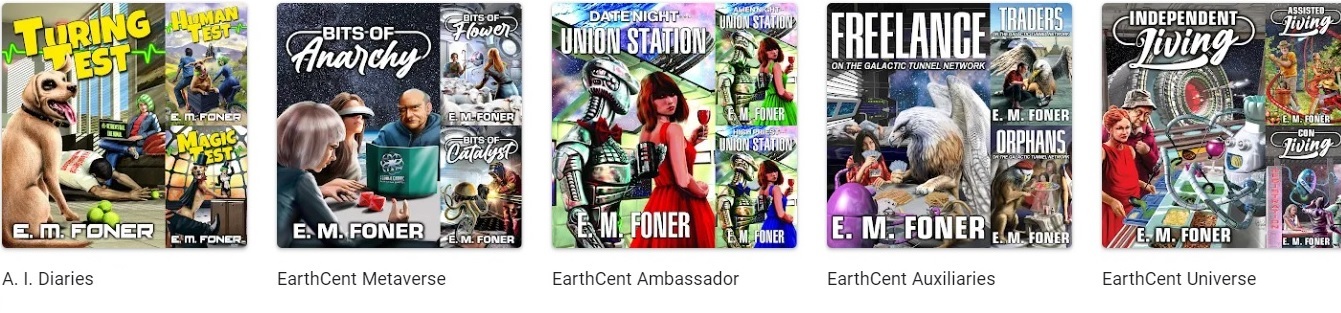
AI publishers, I won't call them self-publishers because they aren't publishing their own work, use Amazon bestselling category lists and sales ranks to micro-target market segments, for which they task an AI to write a book. Then they ask the artificial intelligence for a cover, for artwork like a cast of characters to add to the product page, to write a compelling author biography, and they throw money at the Amazon advertising system to get the first book of a series selling. My pen name, E. M. Foner, currently carries a suggested price tag of $2.87 per click in the Amazon advertising system, which is more than I earn selling a book. But to an AI publisher breaking in with a series that they're going to release at the rate of a book a month, faster if they dare, they can lose $10 or $20 selling book one and make it up in Kindle Unlimited reads, sales of follow-on books, and most importantly, visibility.
What sales rank measures best isn't the precise number of sales, but the visibility of a product in the Kindle store, precisely because it's all relative. In addition to a strong sales rank moving a book up the category bestseller lists, it increases the chance Amazon will recommend it to readers who are searching on genres or key words. I would call it a virtuous circle, except there's nothing virtuous about buying visibility, even though it's the only game on Amazon these days.
Some Kindle readers do call out AI slop when it's obvious, but a clever AI publisher willing to take a day to edit a book rather than rushing it right off to the Kindle store can hide most of the AI traces. I understand that students use so-called Humanizers to rewrite the papers they get from AI, so no doubt AI publishers are taking advantage of those as well. While some AI publishers, especially in Romance, make it obvious by publishing new books at a scorching rate, like every other day, more sophisticated operators limit themselves to a book a month to make it easier to pass as human.
I always thought that the meaning of Amazon sales rank was pretty obvious to anybody who took the time to think about it, but most people don't want to think. This is why AI will take over publishing. There are so many people who want to make money without thinking or working, and now they can do it by following a formula for AI publishing. Unfortunately, most readers don't want to think, they want to read books that get them through a few hours and then are forgotten like the last TV show. There's an important way in which books are like government. Readers end up with the books that they deserve.
Copyright 2026 by Morris Rosenthal
Amazon Sales Rank | Book Contract Negotiation | Cover Design and Page Layout POD Case Study | Industry Book Sales | SciFi eBook Publishing | Indexing a Book in Word | The Path to Publication | Self Publishing | Foner Books